
How to Choose a Facial Analysis Machine for Your Business?
Choosing a Facial Analysis Machine is not simply a matter of buying the camera with the highest resolution. The right system must fit your services, customer flow, budget, and data responsibilities. A busy skincare clinic may need fast skin imaging, while a research-led salon may require deeper analytics and exportable reports. Small details matter. Can staff calibrate it before opening? Can clients understand the results in one minute? What happens when lighting changes?
Market interest is expanding. Grand View Research estimated the global facial recognition market at USD 5.71 billion in 2021, with continued growth expected through 2030. This figure does not represent every facial analysis application, but it signals stronger demand for intelligent imaging tools. NIST’s Face Recognition Vendor Test also shows that performance can vary across demographic groups. Accuracy should never be treated as a universal promise. It must be tested in real conditions.
Rana el Kaliouby, co-founder of Affectiva, has called emotion AI “the next frontier of artificial intelligence.” Her observation highlights the technology’s potential, but potential is not proof. A responsible Facial Analysis Machine should provide clear accuracy information, secure data handling, staff training, and informed customer consent. ISO-aligned testing, transparent vendor documentation, and practical demonstrations can support better decisions. Still, no device is perfect. Skin tone, shadows, facial movement, and camera angle can change results. This guide examines the features, evidence, costs, and risks that businesses should review before investing.
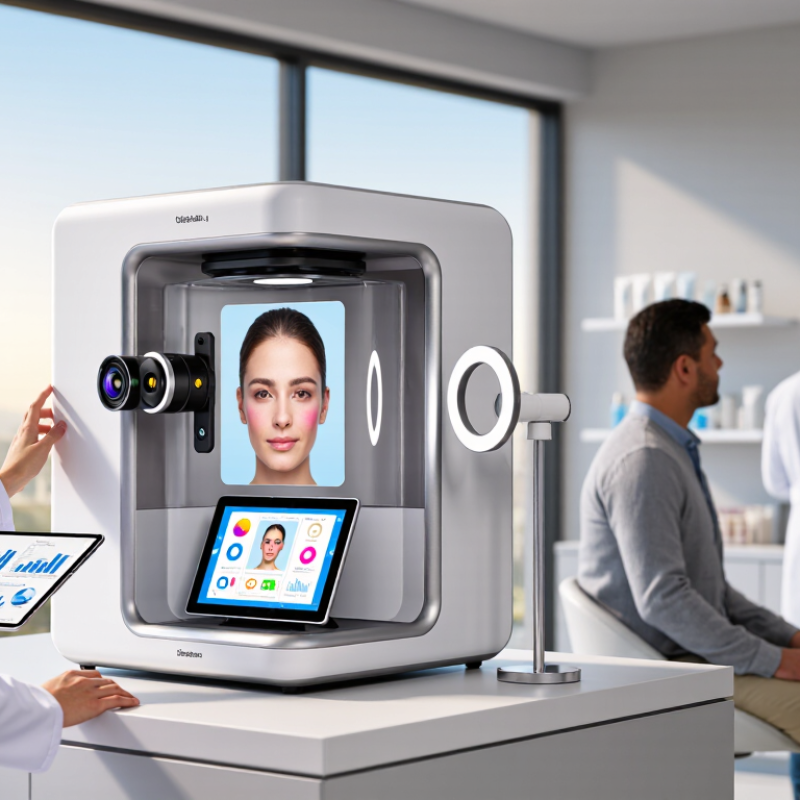
Define Your Business Needs and Target Clients
A reliable facial analysis machine should fit your business, not merely look advanced. Define your target clients before comparing technical specifications. A beauty clinic may need detailed skin hydration, pigmentation, and pore assessments. A spa may value quick consultations and simple visual reports. Retail settings often need fast scanning, clear explanations, and comfortable customer interaction.
Market evidence supports this client-focused approach. McKinsey reports that the global beauty market could reach about $580 billion by 2027, with annual growth near 6%. Grand View Research valued the global skincare products market at approximately $146.7 billion in 2021. These figures suggest strong demand, but demand does not guarantee the right equipment. Review your average appointment length, staff expertise, lighting conditions, and follow-up process. A high-resolution camera can impress clients, yet complicated software may slow daily operations. I would not assume more measurements always create better advice.
Tips: Test the machine with different skin tones and age groups. Ask for documented accuracy results, calibration procedures, training support, and report customization. Check whether the system stores images securely and supports your local privacy requirements. Let two staff members perform the same assessment. If their interpretations differ widely, the workflow needs improvement. A short trial is often more revealing than a polished sales demonstration.
Compare Facial Analysis Technologies and Core Functions
How to Choose a Facial Analysis Machine for Your Business?
Facial analysis machines differ in sensors, algorithms, and reporting depth. Standard RGB cameras capture visible concerns, including redness, texture, pigmentation, and wrinkles. They are affordable and quick, but results depend heavily on lighting and camera distance. Lighting changes everything. Three-dimensional systems map facial contours and improve measurement consistency, especially for wrinkles and skin volume. Multispectral systems examine light responses beyond ordinary color. They may estimate hydration, oiliness, or pigmentation more precisely, but require stronger calibration and staff training.
Market demand is expanding. Grand View Research valued the global facial recognition market at approximately 5.7 billion dollars in 2023. However, market growth does not guarantee clinical usefulness. A machine should offer repeatable measurements, image-quality warnings, and clear comparison reports. NIST’s Face Recognition Vendor Test has repeatedly documented demographic differences in algorithm performance. This reminds buyers to request validation data across skin tones, ages, and lighting conditions. A polished interface is not evidence of accuracy.
In practical testing, compare the same person under controlled lighting. Check whether scores remain stable after repositioning the face. Review core functions such as skin-area mapping, trend tracking, data export, and consent-based storage. Speed matters too. A busy salon may need results within two minutes, while a clinic may prefer deeper analysis. I would also ask how often calibration is required. That detail is easy to overlook. A high score can still mislead when the algorithm cannot explain its measurement. Some devices look impressive during demonstrations, yet perform less consistently in daily use. That gap deserves honest reflection.
How to Choose a Facial Analysis Machine for Your Business? - Compare Facial Analysis Technologies and Core Functions
| Technology Type | Primary Measurement Principle | Typical Outputs | Best-Suited Business Uses | Main Strengths | Key Limitations | Environmental Requirements | Core Functions to Check |
|---|---|---|---|---|---|---|---|
| Standard RGB Camera Analysis | Visible-light images are processed to identify facial landmarks, skin appearance, texture, tone, and visible imperfections. | Skin tone classification, visible spot and wrinkle indicators, pore appearance, redness, oiliness, and comparative scores. | Beauty consultations, cosmetic recommendations, customer education, and basic before-and-after tracking. | Generally affordable, fast, widely compatible with computers and tablets, and easy to deploy. | Results can change with lighting, makeup, camera angle, facial expression, and image quality. It mainly evaluates visible appearance rather than deeper tissue properties. | Requires consistent, diffuse lighting and a fixed capture distance for reliable comparisons. | Guided positioning, exposure control, image-quality checks, standardized lighting, report export, and repeat-visit comparison. |
| Polarized-Light Imaging | Cross-polarized or parallel-polarized illumination reduces surface glare and emphasizes selected optical properties of the skin. | Improved visualization of redness, pigmentation contrast, uneven tone, and selected surface features. | Professional skin consultations, treatment planning, progress documentation, and standardized cosmetic assessments. | Produces more consistent images than ordinary photography for certain skin-appearance comparisons and reduces distracting reflections. | It does not directly measure every biological or structural property of the skin. Interpretation depends on calibration and controlled capture conditions. | Needs controlled illumination, fixed camera settings, and a clean lens or contact surface where applicable. | Multiple illumination modes, glare reduction, calibration reference, side-by-side comparison, lesion or area marking, and data export. |
| Ultraviolet Imaging | Ultraviolet illumination reveals fluorescence or contrast differences that are not normally visible under standard room lighting. | Indicators associated with surface oil, some pigmentation patterns, follicular visibility, and selected photodamage-related features. | Advanced cosmetic consultations, educational demonstrations, and monitoring of visible skin patterns over time. | Can reveal contrast patterns that standard visible-light images may not show clearly. | Findings are appearance indicators, not a medical diagnosis. Results vary with skin condition, cosmetics, camera settings, and device calibration. | Requires a controlled, shielded imaging area and appropriate eye-safety procedures. Avoid unnecessary exposure and follow the equipment instructions. | Safe operating controls, UV intensity management, image capture presets, calibration, privacy protection, and clear non-diagnostic reporting. |
| Multispectral or Hyperspectral Imaging | Captures image information across several or many wavelength bands beyond ordinary RGB channels. | Spectral maps, pigmentation and redness indices, reflectance patterns, and advanced comparative measurements. | Research-oriented clinics, advanced aesthetic practices, product testing, formulation support, and high-detail skin monitoring. | Provides richer spectral information and may improve differentiation of selected appearance characteristics. | Higher purchase and maintenance costs, more complex interpretation, and greater dependence on validated algorithms and calibration. | Needs stable illumination, controlled positioning, regular calibration, and staff training. | Spectral calibration, region-of-interest analysis, algorithm transparency, raw-data access, measurement repeatability, and professional reporting. |
| 3D Structured-Light Scanning | Projects a known light pattern onto the face and calculates surface geometry from pattern distortion. | Facial contour, volume, symmetry, surface relief, wrinkle depth estimates, and three-dimensional distance measurements. | Aesthetic procedure planning, facial contour assessment, progress tracking, and customized service consultations. | Captures measurable surface shape and depth rather than relying only on two-dimensional photographs. | Facial movement, hair, reflective products, poor positioning, and occlusion can reduce scan quality. It does not identify all skin conditions. | Requires stable positioning, adequate space, controlled ambient light, and a short period of stillness during capture. | 3D mesh generation, landmark measurement, symmetry analysis, depth mapping, scan alignment, and secure 3D-data storage. |
| Near-Infrared Imaging | Uses near-infrared wavelengths to record reflectance behavior that differs from visible-light imaging. | Additional contrast information, selected subsurface-appearance indicators, and comparative maps depending on wavelength and algorithm design. | Advanced skin research, professional monitoring, and applications requiring information beyond standard color imaging. | Less dependent on visible color alone and can provide complementary information to RGB images. | Performance varies by wavelength and skin type. It should not be treated as a standalone diagnostic method without appropriate clinical validation. | Requires wavelength-specific calibration, stable illumination, and controlled acquisition settings. | Multi-wavelength capture, calibration logs, repeatability testing, image registration, quantitative mapping, and standards-based data export. |
| AI-Based Facial Landmark and Image Analysis | Computer-vision models detect facial landmarks and classify or quantify image features using trained algorithms. | Facial proportions, symmetry, feature locations, image-quality scores, appearance categories, and personalized recommendation outputs. | High-volume consultations, remote pre-assessments, customer engagement, service personalization, and automated reporting. | Fast, scalable, and capable of standardizing repetitive measurements when the model and image conditions are properly validated. | Accuracy depends on training data, lighting, pose, image quality, demographic coverage, and model validation. Algorithmic outputs should be reviewed by trained staff. | Needs consistent image capture, suitable computing resources, software updates, and clear procedures for handling failed or uncertain results. | Confidence scores, manual review, bias testing, audit logs, consent management, local or cloud processing options, and API or report integration. |
Evaluate Accuracy, Usability, and Data Privacy
Choosing a facial analysis machine starts with accuracy, not impressive screens. In practice, accuracy depends on lighting, skin tones, camera distance, and operator technique. Ask suppliers for independent validation data, not only laboratory claims. Check sensitivity, specificity, repeatability, and error rates across diverse subjects. Request a live demonstration in your treatment room. A bright window can change results. Test readings during morning and evening conditions. Compare repeated scans from the same person. Small variations may reveal unstable hardware or software.
Usability determines whether staff use the system consistently. The interface should show clear measurements without overwhelming clients. A scan should require simple positioning, quick cleaning, and minimal training. Watch a new employee perform the full process. If instructions need constant explanation, the workflow is not ready. Exportable reports can support consultations, but avoid presenting estimates as medical diagnoses. That distinction protects trust. I would also test glasses, makeup, facial hair, and movement. Real clients rarely stand perfectly still.
Data privacy deserves equal attention. Confirm what data the machine collects, where it is stored, and who can access it. Favor strong authentication, encryption, limited retention, and clear deletion controls. Obtain informed consent before capturing facial images. Explain the purpose in plain language. Do not collect more than the service requires. Review contracts, security updates, breach procedures, and regional privacy obligations with qualified advisers. A polished device can still create risk. My evaluation would include a small pilot, documented errors, staff feedback, and a second review before purchase.
Assess Costs, Support, and Long-Term Value
How to Choose a Facial Analysis Machine for Your Business?
Assess Costs, Support, and Long-Term Value
Choosing a facial analysis machine requires more than comparing prices. A practical evaluation should examine image quality, analysis speed, software stability, and ease of use. Test the machine with different skin tones, lighting conditions, and age groups. A device that performs well in a bright showroom may struggle under ordinary salon lighting. Real conditions matter.
Calculate the total cost, not only the purchase price. Include installation, staff training, maintenance, software fees, and possible replacement parts. Ask whether updates are included and how often the system receives them. Support can affect daily operations significantly. Confirm response times, training materials, remote assistance, and local service availability. Get these details in writing. Promises can be vague.
Long-term value depends on useful results, not impressive screens. The reports should be clear enough for staff to explain without exaggeration. Customers should understand what the analysis can and cannot show. Protect personal information through consent procedures, limited access, and secure storage. Requirements may vary by location, so professional legal advice can be appropriate. No machine is perfect. Some readings may change with makeup, dehydration, or poor lighting. Record these limitations honestly, then review performance after three and six months. A simple log of errors, repairs, training time, and customer feedback can reveal whether the investment truly supports the business.
Test, Select, and Implement the Right Machine
How to Choose a Facial Analysis Machine for Your Business?
Test, Select, and Implement the Right Machine
Choosing a facial analysis machine should begin with your service goals. Decide whether you need skin hydration readings, pore visibility, wrinkle tracking, or consultation support. Then test several machines under real working conditions. Use the same volunteer, room, and lighting for each trial. Start small. A device can perform well in a demonstration but struggle beside a bright window.
Check measurement repeatability, image clarity, operating speed, and software usability. Ask for technical documentation and training details. During one trial, uneven lighting produced different skin readings within minutes. That result was useful, although disappointing. It showed why controlled testing matters more than impressive sales claims. Compare results with trained visual assessments, but do not treat either method as perfect.
Select equipment that fits your staff, budget, treatment flow, and maintenance capacity. Confirm that users provide informed consent before image capture. Store records securely, limit access, and explain how data will be used. A short pilot can reveal practical problems, such as slow uploads or confusing reports. Train every operator with the same procedure, including camera distance and client positioning. Review results after several weeks. The first setup may need adjustment. Reliable implementation is an ongoing process, not a one-day purchase.
How to Choose a Facial Analysis Machine for Your Business?
Use a structured test to compare facial analysis machines before purchase. The chart below shows a practical 100-point evaluation framework covering image quality, measurement consistency, workflow efficiency, reporting, usability, and implementation support.
How to use the chart: Test each machine under the same lighting, distance, operator instructions, and client conditions. Select the system with the strongest overall balance for your business, then validate staff training, data protection, maintenance, and workflow integration before implementation.